Seamless Work
Exploring a resilient model for distributed work.
We spend the majority of our lives working. Autonomous organizations offer a new type of structure with the potential to enable new pathways toward contributing, earning a living, and finding community. Under the traditional corporate structure, decision-making is centralized for efficiency, but this also centralizes the dysfunctions of a given firm. If these dysfunctions become too great, an individual must make, in most cases, a significant life decision.
Exploring the autonomous organization structure
DAOs (Decentralized Autonomous Organizations) are hyper-flexible organizational structures that align people towards a common goal. Given the open nature of DAOs, contributing is less structured compared to the traditional corporate structure. The responsibility falls on each DAO to create and organize the necessary structure that guides the types of contributions that are best for the group mission. Many will do this by creating an onboarding process for new members that integrates them into the group and guides them towards the best avenues for their unique skillset. As new members go through this process, they get a sense of the community and its values. From this point, it is up to the new members to decide on their level of contribution. Some DAOs may have an expectation of a minimum contribution to remain an active member. Ultimately, it’s up to the new member to decide how much they would like to contribute and to proactively find avenues for that contribution. The flexibility of this structure allows for composable work. Contributors, empowered with choice, can configure their roles to match their personal weighted preference for earning income, building and practicing skills, and filling the need for community.
The potential of autonomous organizations
If we imagine a future where autonomous organizations are the primary structure for work, an individual would have substantially more optionality and leverage to control their working life. We can also assume that the majority of people would choose to spread their efforts across more than one DAO. Although this system offers great benefits not found in the structure of traditional employment, DAO communities have the potential to develop dysfunctions of their own. But unlike the traditional model, in the case that one DAO becomes dysfunctional, the individual has the ability to more easily reposition their efforts toward other organizations with far less administrative overhead. This network of contributions creates a shock-resistant structure around the individual. If one node fails, the workload can rebalance across the other available nodes.
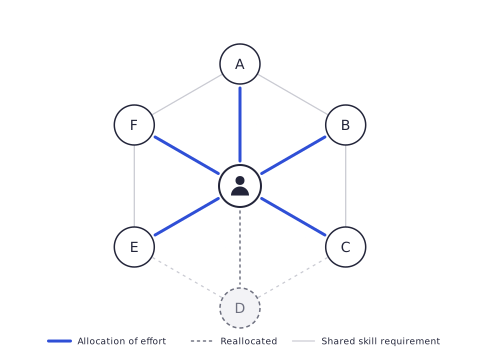
When I explained the idea of Seamless Work to a colleague, his response surfaced a potentially common objection.
“Most people won’t want to balance more than one role. The average person wants to show up to one company and complete their tasks for the day.”
He’s correct, in part. The majority of people won’t intuitively sense the incentive to engage in this system, given how strongly most people have imprinted on traditional labor roles. The base unit of Seamless Work is a skill, and an individual’s unique combination of skills is utilized via a network of independent organizations. The details of where, when, and how an individual brings their skill to bear toward the creation of value for an organization is substantially more flexible than it is under the traditional labor model.
As an example, if we assume the skill in question is the ability to write well: Under the Seamless Work model, a participant’s first step is to initialize a verifiable attestation of their stated skillset. Consider this a Proof of Skill. Once the participant has obtained a verifiable proof of skill, they will be able to engage the open marketplace by signaling their ability and availability and matching with organizations that have signaled their need for a chosen skillset. An attestation for “Writing” as a Proof of Skill could include an article in a reputable publication, a following on social media built around their writing, or a portfolio of writing with its quality verified by a trusted third party. The core idea for the participant is to provide an independent verification that they have sufficient mastery over the skill in question.
An autonomous organization defines a list of tasks that need to be completed and attaches a payout to each, similar to a bounty system. The organization assigns a member to match participants with tasks they are qualified to complete and to verify each participant’s Proof of Skill. Once a participant completes a task, they collect their reward, and their contribution history and reputation accrue independently of any single organization. At its most basic, this functions as a distributed resume. Because each entry is verified at the time of payment, these track records are difficult to falsify, which mitigates bias and inefficiency in the tasking process (or “hiring” in the traditional model).
This form of autonomous organization depends on an individual’s ability to hold several affiliations at once, have their skills verified by a trusted third party, and maintain their contribution history independently.